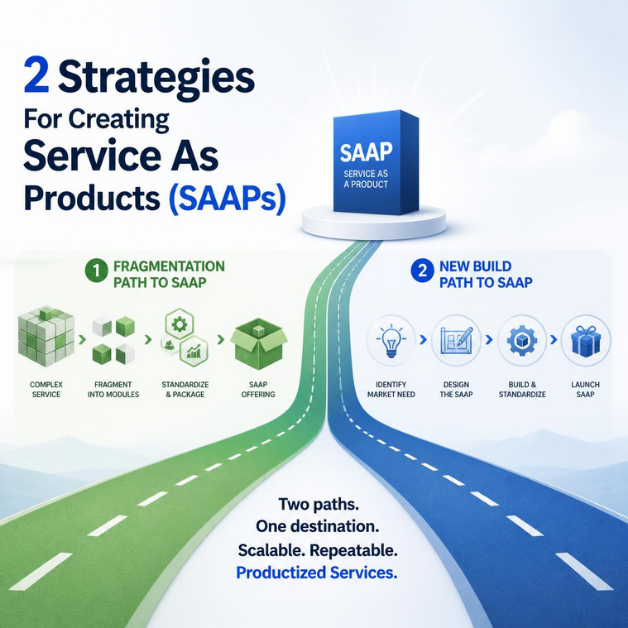
When I developed an interest in productised services and service as a product (SAAP) as a concept, I did some research to find the types of productised services out there. What I found is that there are no existing types of productised services.
Now this is unsurprising considering the fact that the concept in itself was disjointed, broad, and treated as a side project by mostly marketing agency owners who sought only to get out of the demanding service industry.
So most of the definitions of the types of productised services on the internet are based on the pricing model
- Subscription based: retainers for maintenance or unlimited requests for certain tasks paid monthly.
- Fixed pricing: one time payment packages for deliverables or a tiered system (basic, standard, premium).
But none of them directly answered the question “what options does a business owner have when considering building productised services?” Like if you want to get into vehicle manufacture, you can decide to make sedans, SUVs, Coupes, etc., but no one can tell you the types of productised services you can make?
Well, that was the state of things until now.
I recognised that the problem was partly caused by the broad definition of productised services. But after properly defining what a service as a product is, what it is not, and the necessary conditions that must be met before a productised service can be called a SAAP, it became quite clear what types of SAAPs exist.
If you are yet to read about the concept of service as a product, read it here – Service As A Product Model For Businesses.
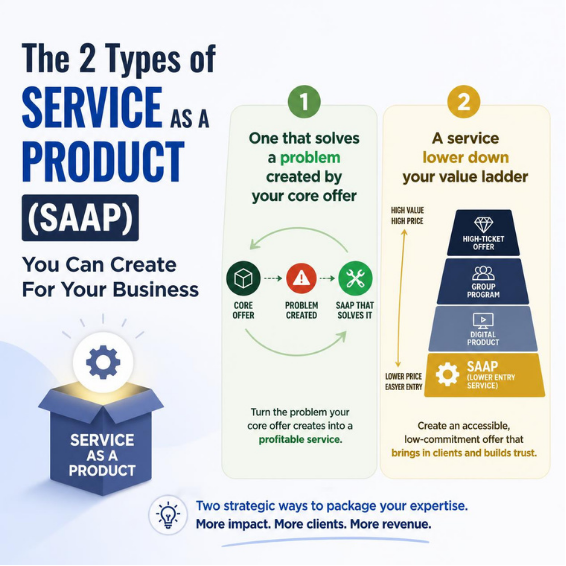
That said, I have identified 2 types of SAAPs that you can set out to build in your business.
The 2 Types of Service As A Product (SAAP) You Can Create
- One that solves a problem created by your core offer – (adjacent but in-domain offer, further down the pipeline)
- A service lower down your value ladder (higher up your pipeline)
1. Solves a problem created by your core offer (Downstream)
This is the “cleanup after yourself” SAAP. If your core service solves complex problems for your clients, there is a good chance that it creates a new, adjacent problem for the clients. You can package the fix as a separate offer.
Examples:
- Wedding photography: core offer is shooting the wedding, but that produces 3,000+ unedited images the couple now has to sort through and turn into an album.
- SAAP: a fixed-price Album Design & Curation package.
- Custom software development: core offer is building the app, but that creates an ongoing need for hosting, bug fixes, and security patches.
- SAAP: a flat-fee monthly Care Plan or maintenance retainer.
2. A service lower down your value ladder (Upstream)
This is the cheaper, lower-commitment entry point that exists to bring people into your funnel before they’re ready for the core offer.
- Management consulting: core offer is a six-figure multi-month strategy engagement
- SAAP is a fixed-price two-day Strategy Sprint workshop that’s cheap enough to be a low-risk first purchase.
- Web design agency: core offer is a $15k custom site build
- SAAP is a $500 Conversion Audit that’s productized, fast to deliver, and naturally surfaces the case for the full rebuild.
I hope this helps as you think of ways to marginally scale your business – Melvin Braide.