This article attempts to define a Service As A Product and differentiate it from other concepts closest to it such as productised services, the gig marketplace SaaP model, and servitisation. Here I also outlined a set of necessary conditions to be met before a productised service can be called a SAAP.
What is a service as a product (SAAP)
The simple definition of a service as a product is a service packaged and sold as a product.
A more comprehensive definition is that it is a component of your service, framework, or unique methodology that is desirable, repeatable, produces a concrete change in the client’s state or assets, and can stand alone as its own deliverable which is sold at a fixed price with a defined scope and timeline.
It is a derivative of the productised services framework and it shares certain similarities with it such as a fixed scope, timeline, price, and a repeatable process. But it expands the definition and is tailor-made for businesses seeking marginal gains without changing their core business model.
What SAAP Is NOT (Comparison with its closest neighbors)
Productised services
Productising a service is the general process of converting a skill, process, or service into a marketable, standardised offering that can be sold repeatedly. It is the parent concept from which SAAP is derived. The core difference between the two definitions lies in whether the final form of the offer is a service or a product.
The final form of some productised services are products. For example, a consultant creating a DIY kit on a specific topic or a course. Whereas, the final form of a SAAP offer has to remain a service rendered.
Servitization
Servitization is the inverse of productising services as it involves turning physical products into services. In this model, instead of buying the products outright, customers pay to use the product or a specific outcome the product can achieve.
Gig Marketplace SaaP
The term SaaP (service as a product) was first coined and credited to the cofounder of Fiverr (the freelance platform) Micha Kaufman to refer specifically to productised services sold through centrally-hosted marketplace platforms.
While it shares certain similarities with the SAAP model discussed in this article such as fixed scope, timeline and price, it is a much narrower concept which reduces the term to a marketplace delivery mechanism associated with the gig economy and not the cross-industry professional framework that has been developed here.
Necessary Conditions for A Productised Service to be called a SAAP
- The final form of a created SAAP must be a service and not a product (no course, checklists, templates, etc): The core idea/differentiator of SAAPs is that you are selling execution and not just information/products. That said, the final deliverable after the SAAP has been executed can always be a product (course, checklists, templates, landing pages, etc).
- It can be complicated, but not complex: Steps can be sequential and deterministic (complicated) without being interdependent/emergent (complex) — i.e., you can still have steps, just not steps that change each other’s outcome unpredictably.
- It must be repeatable (fixed part 80% and variable 20%): SAAPs should be relatively easy to fulfil, hence repeatable. This is a concept some business owners, entrepreneurs and innovators struggle with. They think for anything to be valuable, it has to be complex. Not exactly, you must understand that there are plenty of things you know but don’t apply to your business or things you do that, if offered as independent deliverables, can be valuable to an audience. The fact that it is simple for you to execute does not mean it won’t be appreciated by people who do not have your skillset. You are looking at things from an expert’s POV and not a consumer and that is fallacious thinking because your clients are not experts in your field otherwise they won’t need you.
- It needs to have a fixed price, set scope, and defined Timeline: This is a no brainer. You do this to avoid scope creep, cost creep, and spending more time than necessary on one project which defeats the entire purpose of a standardized service and eats into your profit.
Types of Service As A Product
Because of the lack of standardisation in this mini industry, there were hardly any specified or regularised types of SAAP until I identified 3 types of SAAPs that a business can adopt
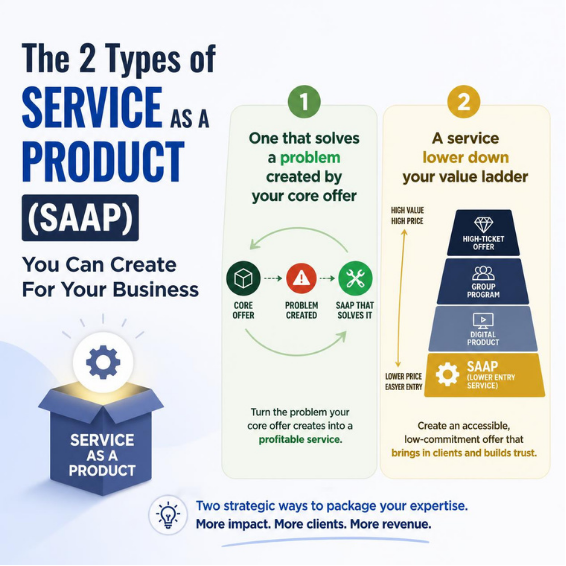
- One that solves a problem created or exposed by your core offer
- A service lower down your value ladder
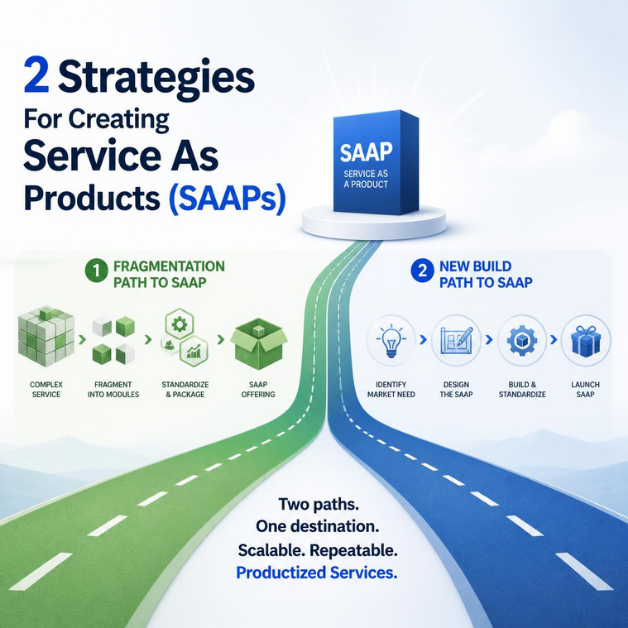
- A fragment of your existing service or unique methodology
SAAPs can be any one of the above types provided they meet the necessary conditions for them to be a service as a product in the first place.
Benefits of adopting a SAAP
- Can help transform your marketing from a cost centre to a profit centre
- Can help introduce your business to a new audience
- Can help scale your business laterally by introducing your existing audience to adjacent offers
- Generates a second stream of revenue for your business